Skip to content
standpoint

The model portfolio is up+16.6%Eleven funds. One rebalance.

  • SPY (TR) over the same window: +12.7%
  • Your money stays in your own account. I never touch it
How the number is measuredAdjusted closes, a published composition, and the index beside it

The model portfolio is a published list of index funds and weights. Its return is computed from adjusted closing prices since the day it went live, and the S&P 500 is measured over the identical window. There is no window selector, because choosing the window is how a record gets flattered.

The figure is the model portfolio alone. The single-name picks are a separate record, measured per position, and are never added to it.

No member capital sits in it and I charge nothing on your assets. You hold it in your own account, so your result will differ with your timing, your broker and your taxes.

The full performance pageDisclosures

Run your own money with a second opinion you can check.

Most of what you own should be boring. StandPoint gives you a model portfolio to hold as it stands, and single names around it when one is worth the risk. You place every trade yourself, in your own account.

  • 251picks closedA separate record, every one public
  • 185trading daysThe model portfolio, against the S&P 500

Built for you to hold

Buy it once and leave it. For the money that should compound quietly.

+16.6%since Jan 2, 2026SPY (TR) +12.7%

The model portfolio

  • Eleven funds, every weight published
  • Rebalanced once since launch, with the reason written down
  • Held in your own account, at your own broker

The chart is the model portfolio since live inception against its benchmark over the same window, end of day. It is a published composition priced at adjusted closes, not an account.

Pick your own

For the part you want to engage with yourself.

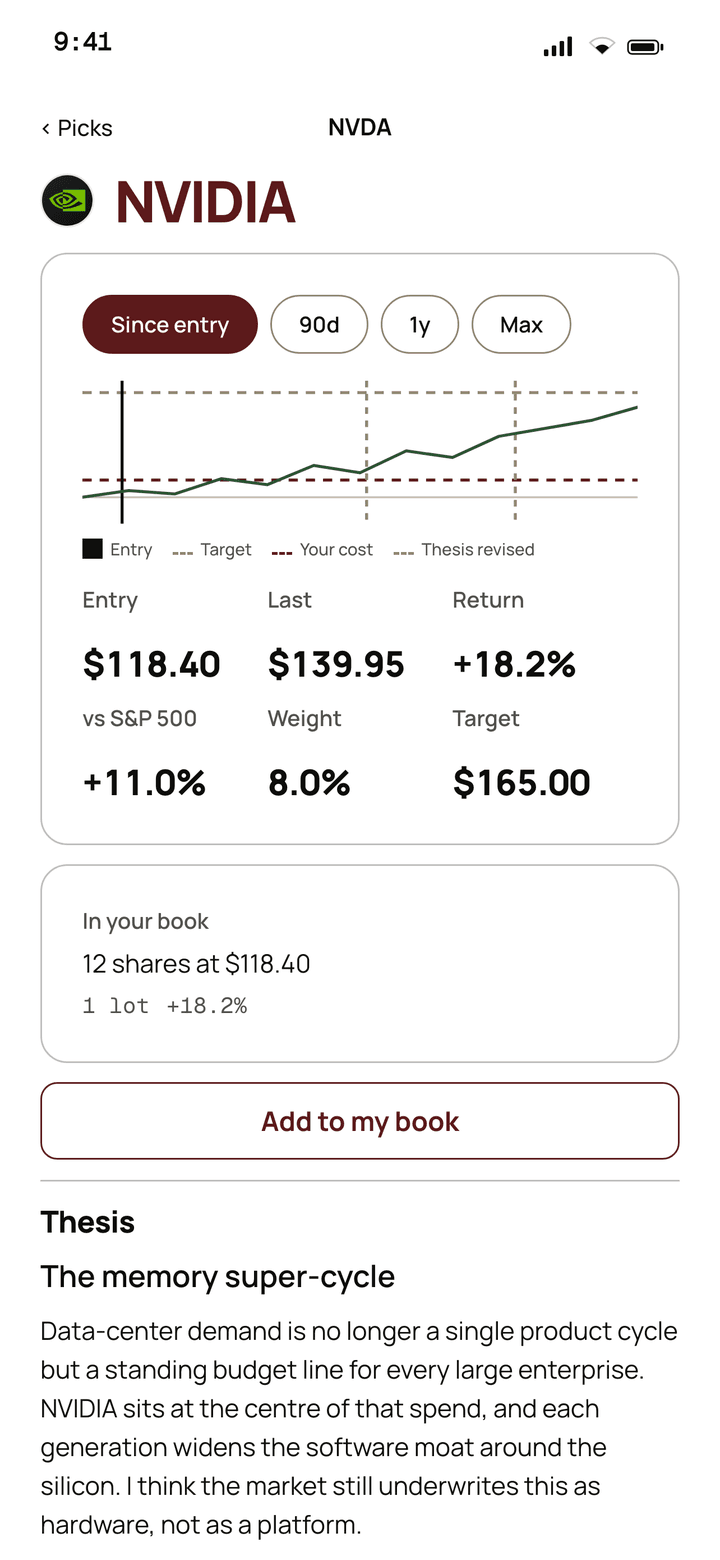
A pick in the StandPoint iOS app: the position's chart, entry, last price and weight, above the written thesis and what would change it.
App screen with sample data.

The picks

  • A separate record from the portfolio: single names, opened when the setup earns one
  • A written thesis with each: why, and what would change my mind

  • Held about a fortnight, then closed in public, winners and losers

Position figures are per position, gross, exit against entry. They are not a portfolio return and are never added to the model portfolio's.

Your names, read every night. And told when something changes.

The desk runs the same reads on what you hold and watch as on its own book. Nothing here is advice: it is arithmetic on your positions and the night's data, shown so you can check it.

  • Forty-six themes

    Nuclear, AI power, robotics, water. Each list priced from our own bars every night, with its breadth and the names in it. Follow one and it lands in your alerts.

  • A watchlist with a level

    Name the price you are waiting for. One push the morning it closes through, then quiet until you change it.

  • Your book, X-rayed

    Beta, sector lean, the pairs that move together, what reports in the next fortnight, and how much of each theme you actually own.

  • Named screens

    Stretched and standing on a level. Reclaimed today. Quality on sale. The screener as sentences, over fourteen hundred names and every theme.

Facts about your book and the lists, never a recommendation. See it in the app

Every theme has its own mark and colour. The closer two lists are in meaning, the closer their colours sit.

One list a year. Written in January, held until December.

The Annual picks are a third way to use the S&P Book. On the first session of each year the screen names the large American companies that move most with the market and least on their own news, fifteen to fifty of them, equal weight. Then nothing: no trades until the next January.

Know what you hold: the list moves about 1.4 times the market. Its worst year was 2022 at −4.9%, and inside a year it has fallen as far as −41.0% (2020).

Ahead of SPY in six of seven years

  • Annual picks
  • SPY, same window
2020202120222023202420252026
2020
+31.9%
SPY +17.3%
15 names
2021
+42.9%
SPY +30.5%
34 names
2022
−4.9%
SPY −18.6%
37 names
2023
+69.0%
SPY +26.7%
15 names
2024
+10.7%
SPY +25.6%
15 names
2025
+60.8%
SPY +18.0%
16 names
2026to date
+78.3%
SPY +12.7%
17 names

Equal weight, entry at the first session of the year, exit at the last, dividends reinvested, from Jan 2, 2020 to Sep 28, 2026. Each list was built from the data as it stood on its 1 January. A separate record from the model portfolio above: the two are never combined. Past results do not predict future ones.

positions closed in public
251
average hold
16d
America and Europe
3 books
of your money ever held by me
0 CHF

No testimonials here yet. When members agree to be quoted by name and profession, they will be. Until then the record is the reference.

Serious research made readable.

Get started

Questions? Five things to know in five minutes or less.

For everything else, there is the help and guide.

Do you manage my money?

No. StandPoint is a publication, not a manager. You hold everything in your own brokerage account and place every trade yourself. I never have access to your money, and nothing here is personalized advice.

What does it cost? Is there a minimum?

One book is 850 CHF a year, two are 1 450 CHF, all three are 1 890 CHF. The price depends on how many books you take, not which. There is no minimum portfolio and no fee on your assets, and you can cancel any time from your account.

How is the model portfolio's return measured?

From adjusted closing prices against a published composition, since the day it went live, beside the S&P 500 over the identical window. No member capital sits in it, there is no window to choose, and the worst drawdown is shown next to the return. The performance page sets out the method in full.

What is a book, and which one do I start with?

A book is a market I cover, and everything I publish about it. Most people start with the S&P Book: the large American names, and it carries the model portfolio and the nightly screen. Adding Nasdaq or Europe later costs exactly what adding it now would.

How are the picks different from the model portfolio?

The model portfolio is the core: index funds, held, rebalanced about every four months. The picks are single names around it, opened when the setup earns one and held about a fortnight. They are measured differently, and the two numbers are never added together.

Or follow the chronicle

The Morning Chronicle.

Salomon’s daily note on the day’s tape. Five mornings a week, before the open.